
What does an organiser do after the show closes?
Usually, it produces a post-show report. Such reports run to dozens of pages and cover where buyers came from, how many attended, the exhibitor mix, and deal values.
But few people read a full post-show report from cover to cover.
Some organisers take a different route: they write thank-you letters addressed to specific groups.
Unlike the long report, a short letter actually gets read.
The reason is not length. It is function.
In fact, the thank-you letter is the most underrated genre in the exhibition industry.
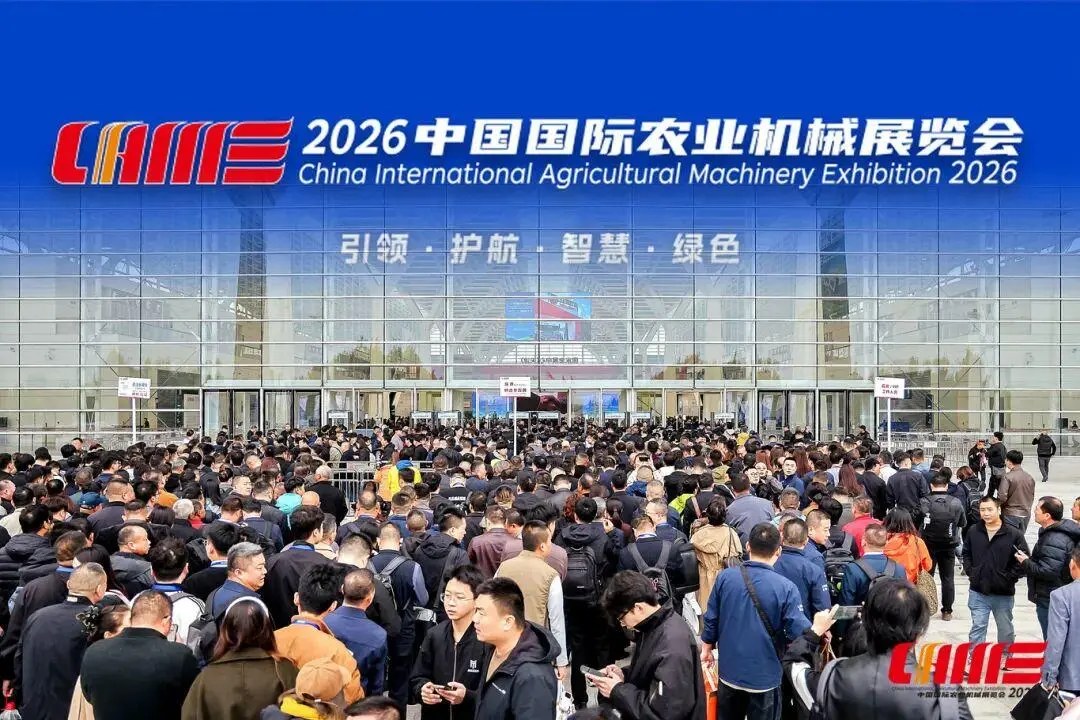
On 28 October, the China Agricultural Machinery Distribution Association, the China Agricultural Mechanization Association and the China Agricultural Machinery Industry Association jointly released "A Thank-You Letter from the Organisers of the China International Agricultural Machinery Exhibition to the Whole Industry and the Whole of Society".
The letter turns gratitude into structure. It can be broken into five moves: define the audience, explain the coordination, acknowledge the city, report the numbers, and make a commitment. Each move answers a real problem in running a mega-exhibition.
Below, the letter's text is quoted section by section, with commentary.
1. The salutation fixes the audience
From the letter:
"Respected exhibitors, visitor friends, service and support teams, and dear friends among the people of Tianjin:
At 4:30 pm on 28 October 2026, as the closing chime sounded at the National Convention and Exhibition Center (Tianjin), the three-day 2026 China International Agricultural Machinery Exhibition officially came to a close. On behalf of the organisers, the China Agricultural Machinery Distribution Association, the China Agricultural Mechanization Association and the China Agricultural Machinery Industry Association extend to you our sincerest thanks and highest respect."
The salutation names four groups: exhibitors, visitors, service and support teams, and the people of Tianjin.
Most thank-you letters from organisers address "exhibiting enterprises and visitors" — an industry and a set of professional groups.
CAME put "the whole of society" in the title and "the people of the city" in the salutation.
For the agricultural machinery industry, nearly 300,000 square metres and 3,168 companies represent the annual gathering of the entire supply chain — close in nature to an industry Olympiad.
For the city of Tianjin, 200,000 visits within three days, more than 100,000 of them from out of town, put transport, security, fire safety, public health and hospitality under simultaneous strain.
This is no longer an industry event. It is a city-wide occasion held under the name of agricultural machinery, and the most direct expression of integrated development across culture, commerce, tourism, sport and exhibitions.
Once a show reaches this scale, its boundary is no longer the red line around the venue but the carrying capacity of the city.
That the organisers voluntarily listed "the whole of society" as a recipient is the kind of self-awareness only a mature organiser has.
2. Thanking exhibitors means naming specifics
From the letter:
"Thank you, the more than 3,000 exhibiting companies. You brought the latest achievements of China's agricultural machinery and equipment industry — the most advanced power-shift tractors, electric continuously variable transmission assemblies, plant protection drones and machinery suited to hills and mountains."
This sentence deserves separate attention. It does not say "thank you for your support". It breaks support into four concrete things: power-shift tractors, electric CVT assemblies, plant protection drones, and hill-and-mountain machinery.
Four nouns that map exactly onto four current technical routes in agricultural equipment.
The most common failure in a thank-you letter is emptiness. The cause is not insincerity but an inability to say concretely what someone contributed. Naming specific products and specific technical routes shows the organisers genuinely understood what was on the floor.
3. Thanking the city means acknowledging a whole system
From the letter:
"Thank you, dear friends among the people of Tianjin. The exhibition moved to Tianjin for the first time, and the city received this 'gathering of steel' with great goodwill. You absorbed the sudden surge of people and traffic, and even treated the agricultural machinery elements spread across the urban districts as part of the cityscape to be observed and approached. A city's generosity shows precisely in its willingness to make room and offer a smile for an industry event. This host's kindness is remembered by the three Chinese agricultural machinery associations, by more than 3,000 exhibitors, by more than 100,000 out-of-town visitors, and by the entire industry."
The five words "moved to Tianjin for the first time" are the most easily overlooked information in the letter, and the most direct endorsement the organisers gave the host city and venue.
From an organiser's perspective, changing city makes every problem a new problem: which road will jam, at what hour peak flows hit which entrance, how fire lanes connect to the surrounding road network, how hotel capacity is allocated, how staff and volunteers are trained, how emergency response is commanded.
Holding the show in the same venue year after year lowers the difficulty considerably — muscle memory solves most of it. Moving to a new city and a new venue means no inherited experience, only a few days to get up to speed, and everything built from zero.
That is why the list of named recipients in the letter reads like a map of urban coordination:
"Thank you, every member of the service and support staff and friends in the media. The Tianjin Municipal Agriculture Commission, the Commerce Bureau, the Public Security Bureau, the Jinnan District government, the venue and all relevant units stood watch day and night across security, transport, fire safety, public health and hospitality; main contractor services, logistics and transport, registration, security staffing, volunteers, hotel reception, fleet dispatch, atmosphere creation and stand construction delivered professionally and quietly, keeping the venue and its surroundings running smoothly and in good order."
This passage turns "a city's capacity to host" from an abstraction into a checkable list of posts.
Whether a major exhibition lands successfully ultimately depends not on how complete the organiser's plan is, but on whether the city's relevant departments can organise themselves into a single machine across the few days around the show.
Conversely, the organisers' willingness to name names so specifically shows the coordination mechanism genuinely worked.
4. Reporting numbers means reporting structural change
From the letter:
"This edition achieved full indoor exhibition for the first time, with nearly 300,000 square metres of exhibition space, 3,168 exhibitors, growth of about 27 per cent, the share of custom-built stands rising to 52 per cent, and custom-built stands among parts suppliers growing about 115 per cent. The exhibition has moved firmly from 'pursuing scale' to 'emphasising quality'."
This is the most objective part of the letter, almost free of subjective colour.
The figures support the shift from scale to quality.
A 52 per cent custom-build share means more than half the stands were not simple assemblies of standard booths, but substantial investments companies chose to make. Willingness to invest is a direct measure of show quality.
Growth of 115 per cent in custom-built parts stands shows competition moving from complete machines down to the supporting tier, with supply chain maturity rising and the show's ecosystem tightening.
In addition, one-to-one meetings with more than 700 buyers from over 30 countries indicate that internationalisation is becoming the show's moat — and the opportunity and challenge facing China's leading exhibitions in the years ahead.
A show's real report card is not how much floor space it added, but whether more participants in the exhibitor mix are willing to invest.
5. Coordination shows at the closing hour
One line in the letter is easy to read past:
"All companies held on until the final moment of normal closing on 28 October, then began dismantling in an orderly way under the organisers' coordinated arrangements."
More than 3,000 companies dismantling simultaneously is the highest-risk window of any major exhibition: vehicles flooding in, aisles jammed instantly, demolition work interleaved with people moving.
Getting 3,168 companies to hold the line at closing and then leave in coordinated sequence requires four things to hold at once: a dismantling timetable, vehicle dispatch batches, one-way aisle control, and an on-site command system.
It is like a major sporting event. Getting tens of thousands of people to the venue is not the problem. Getting them all to leave at the same time is the test.
At this scale, order at closing is the real exam paper for professionalism.
That the letter singled out this detail shows precisely the organic coordination among organiser, city and venue.
6. A commitment sets next edition's acceptance criteria
From the letter:
"Larger in scale, higher in quality, broader in influence, stronger in transactions — this is not the organisers' self-assessment, but a conclusion written jointly by every one of you with your footsteps, sweat and trust."
One sentence hands the credit away.
In public relations terms this is a precise transfer: the organisers do not claim success themselves but make exhibitors, visitors, service providers and residents the co-authors of it. Let the facts speak, and bring everyone into the outcome.
Then comes the commitment:
"We know well that the success of one exhibition is never the end point. The organisers and the project team will go through every suggestion, every inconvenience and every expectation received during this edition, summarise carefully, respond actively to industry needs, continue to innovate and improve service and support measures, and push the exhibition to further quality upgrading. The China International Agricultural Machinery Exhibition has travelled the road from an order fair to a world-renowned industry exhibition; the road ahead must be walked with more solid review, more sincere improvement and more sustained innovation. We commit: the next edition will be held at a higher level, with more distinctive features and greater practical results."
This is not courtesy. It publicly commits to a closed loop of collecting feedback, building a problem list and taking corrective measures — effectively handing the industry next edition's acceptance criteria in advance.
What matters in a thank-you letter is not how many nice things it says, but whether it dares to put its improvement commitments in plain sight.
One letter doing three jobs at once
Three days after the show, the lights in the halls go out one by one and the city returns to normal.
Outsiders see the alternation of bustle and calm. Beneath the calm, the organisers have only just caught their breath.
For the exhibition industry, a well-written thank-you letter is in fact a public act of self-restraint.
The CAME 2026 letter does three things at the same time.
First, it closes the show. Not with a vague "successful conclusion", but by writing the closing itself as an orderly finish.
Second, it delivers the report card. 3,168 companies, nearly 300,000 square metres, 200,000 visits, more than 700 buyers from over 30 countries — figures that land on structure rather than on adjectives.
Third, it grounds gratitude in specific people and specific acts. Every traffic control point, every question answered, every handover coordinated, every emergency response — a show's success is built point by point, and depends on every unit and every person involved.
That is roughly why a thank-you letter is worth reading more than a post-show report. A report is written for the process. A letter is written for people.