
Headlines

National First: Suzhou's New Rules Let Delivery Riders 'Afford to Wait' at Red Lights

社会民生
National First: Suzhou's New Rules Let Delivery Riders 'Afford to Wait' at Red Lights

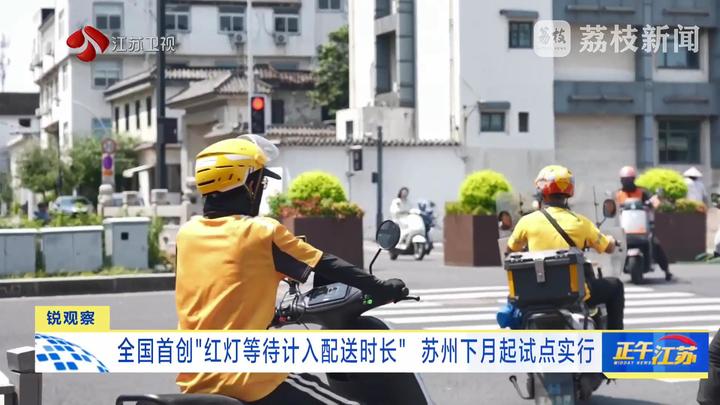
On July 14, Suzhou traffic management authorities announced a groundbreaking new measure — the first of its kind nationally — to formally include delivery riders' red light waiting time in delivery timing systems, enabling riders to 'afford to wait' at red lights. The new policy will be piloted from early August in Gusu District and the Suzhou Industrial Park.

Previously, delivery timing only accounted for riding distance and travel time, with red light waiting not factored in, forcing some riders to risk violations to meet delivery deadlines. Suzhou's new policy addresses this dilemma at its institutional root, eliminating the conflict between 'obeying the law means being late, rushing ensures income.'

In implementation, traffic management departments will connect road condition and violation warning data with instant delivery platforms' operational data, incorporating red light waiting time into delivery order duration. The system will automatically remove invalid timing and extend delivery deadlines accordingly.

Simultaneously, mandatory rest reminders after 4 consecutive hours of delivery and mandatory offline mechanisms after 12 hours will be implemented. Suzhou is also launching a monthly positive incentive system with a safety points management scheme, where points can be exchanged for cash rewards, phone credit subsidies, meal discounts, free medical checkups, and even residence permit points.

Jiang Zhen, commander of the Suzhou Public Security Bureau Traffic Management Detachment, stated that once this model matures, it will be gradually extended to ride-hailing drivers, taxi drivers, urban freight delivery, and other emerging business sectors.

Industry社会民生

Related Articles

Ministry of Commerce and GAD Implement Temporary Export Ban on Helium

China's Ministry of Commerce and General Administration of Customs imposed a temporary export ban on helium. With approximately 85% of China's helium reliant on imports, the measure aims to secure domestic supply for critical sectors including semiconductors and healthcare.

How Did an Expo Give Birth to a Global Governance Organization?

From WAIC to WAICO: 29 countries signed the agreement in Shanghai to establish the world's first intergovernmental organization in AI.

Rental Demand Rises in Shenzhen and Other Tier-1 Cities, Rent-to-Price Ratio Continues Climbing

Rental demand continues to rise in Shenzhen and other first-tier cities, with the rent-to-price ratio steadily climbing. The leasing market is becoming more active as housing rental transitions from a temporary choice to a long-term living arrangement.

China's Economy Demonstrates Strong Resilience and Vitality (Official Release)

China's H1 2026 GDP reached 69.6 trillion yuan, up 4.7% year-on-year. The National Bureau of Statistics stated the Chinese economy shows strong resilience and vitality, with major indicators running within reasonable ranges and new growth drivers contributing over 40%.

New Consumer Opportunities: First National-Level Special Plan Released

China's first national-level consumer spending special plan was released, comprehensively deploying measures to expand consumer demand, optimize supply, and improve the consumption environment, with emphasis on digital, green, and service consumption.

800 Billion Yuan 'Dual Priorities' Funding Fully Disbursed, Policy Effects Accelerating

800 billion yuan in 'dual priorities' construction funding has been fully allocated. Of 1.3 trillion yuan in ultra-long special treasury bonds, 800 billion targets major national strategies and security capacity building. Projects were streamlined to 1,417, with disbursement pace notably faster than previous years.