
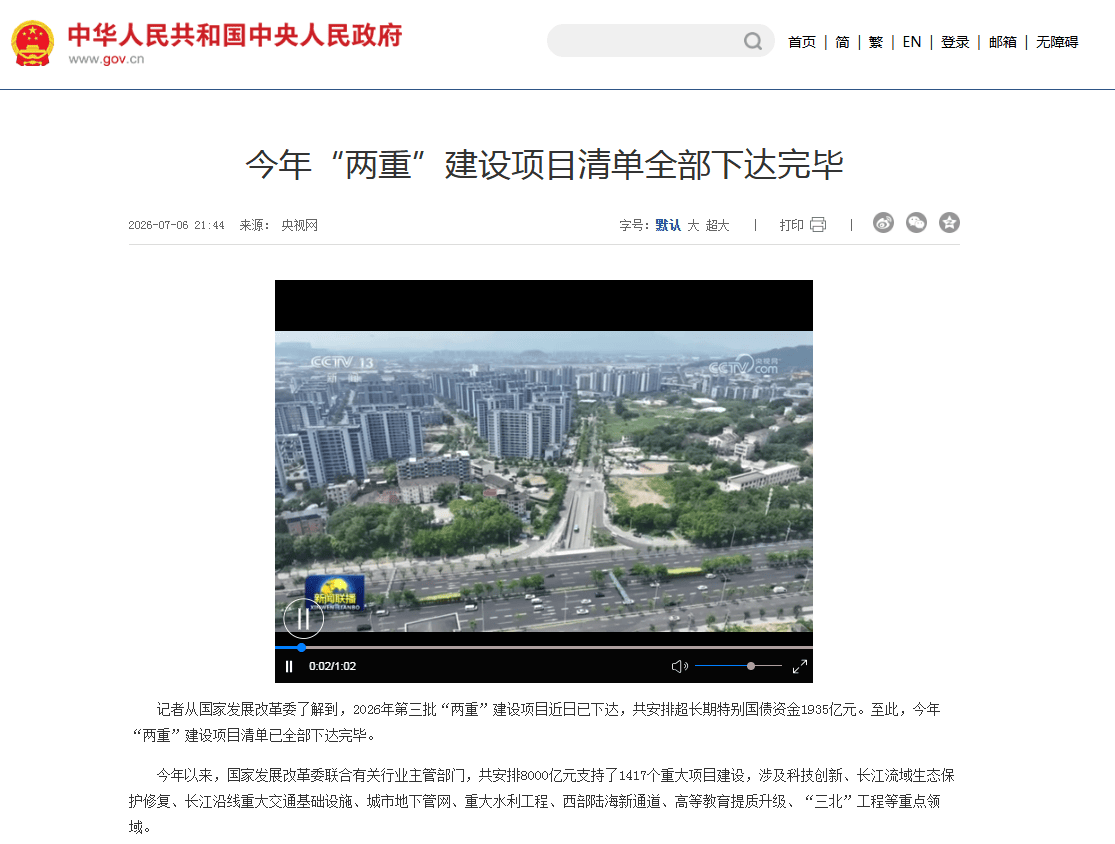
With 800 billion yuan in 'dual priorities' construction funding fully allocated, a comprehensive package of economic stabilization policies is accelerating implementation. On July 13, State Council Premier Li Qiang chaired a symposium with economic experts and business leaders, emphasizing the need to increase counter-cyclical adjustment, make full use of existing policies, and prepare reserve policies.
'Dual priorities' construction — referring to implementation of major national strategies and security capacity building in key areas — is a critical allocation of ultra-long special treasury bonds. In 2026, China allocated 1.3 trillion yuan in ultra-long special treasury bonds, with 800 billion for 'dual priorities,' 200 billion for large-scale equipment upgrades, and 250 billion for consumer goods trade-ins.
Compared to previous years, the 2026 'dual priorities' construction features 'increased intensity, practical results, and long-term planning.' The number of projects was streamlined from 1,459 to 1,417, with higher per-project funding intensity and more focused allocation. Scientific innovation and higher education quality improvement are newly added investment areas.
In terms of disbursement pace, the first two batches of 'dual priorities' funding totaled 606.5 billion yuan, 76% of the annual total, significantly ahead of last year's pace of less than 500 billion yuan at the same stage. This arrangement effectively avoids the problems of funding concentration in the second half and winter construction limitations.
In implementation approach, this year adheres to integrated 'hard projects + soft institutional building,' promoting improvements in urban underground pipeline construction investment models, agricultural water-saving incentive mechanisms in irrigation districts, and accelerated development of modern logistics standards.
Yang Zhiyong, President of the China Fiscal Science Research Institute, believes ultra-long special treasury bonds are playing key roles in cross-cyclical adjustment, targeted support, and domestic demand stimulation. The 800 billion yuan will effectively drive follow-on social investment, generating multiplier effects.
NDRC data shows that from January to May this year, equipment and tool purchases grew 9.3% year-on-year, accounting for 17.5% of total investment, up 2.2 percentage points from the same period last year, indicating accelerating policy effects.