
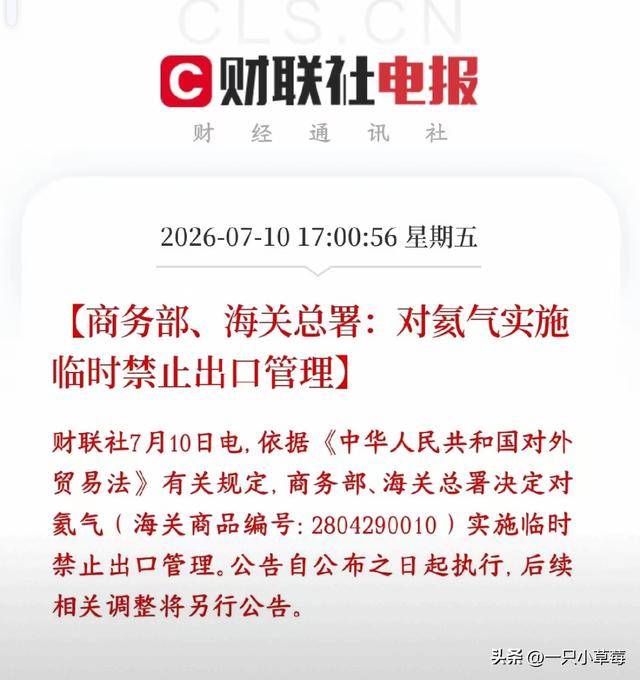
On July 10, the Ministry of Commerce and the General Administration of Customs jointly issued Announcement No. 29 of 2026, deciding to implement temporary export prohibition on helium (Customs commodity code: 2804290010) in accordance with the Foreign Trade Law of the PRC. The announcement takes effect immediately upon publication.
On July 16, He Yadong, spokesperson for the Ministry of Commerce, explained at a regular press conference that China is a major helium importing country. To ensure domestic supply, the Ministry and GAD jointly issued the announcement to implement temporary export controls on helium. This measure complies with the Foreign Trade Law and WTO rules. Future export management policies will be adjusted according to domestic and international helium supply-demand changes.
Helium, a rare inert gas, is classified as a strategic resource. It is widely used in semiconductor manufacturing, MRI superconducting magnets, rocket fuel pressurization, and other aerospace and defense applications, earning the nickname 'golden gas.' In semiconductor manufacturing, helium plays an irreplaceable role with no viable alternatives, being extensively used in wafer cooling, lithography processes, and leak detection.
Historically, China has been one of the world's largest helium importers with limited exports. Approximately 85% of helium is imported, with Qatar supplying over half of China's helium imports. Major Chinese helium export markets in 2024 included the EU, Japan, France, South Korea, and the United States.
Recently, global helium supply chains face multiple pressures. Middle East instability has repeatedly affected Qatar's supply reliability, while Russia has included helium in temporary export controls extending through 2027. Uncertainty has risen simultaneously on two critical supply lines.
According to prior CCTV Finance reporting, a special gas production enterprise executive in Shanghai noted that helium demand has surged significantly, with the factory running double shifts but still unable to meet demand. The semiconductor industry requires enormous helium volumes, with prices changing daily and current daily production doubling from the beginning of the year.