
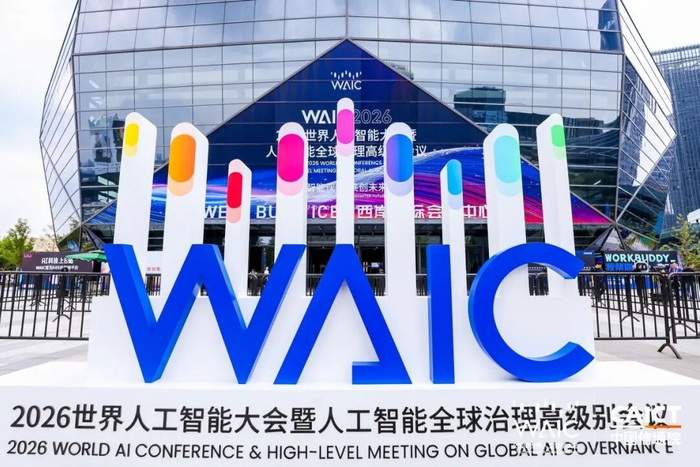
On July 17, the 2026 World Artificial Intelligence Conference and the High-Level Meeting on Global AI Governance (WAIC) opened in Shanghai. This year's conference set new records in exhibition scale and number of debut products — total exhibition space exceeded 100,000 square meters for the first time, with over 1,100 companies participating and more than 3,000 exhibits on display, including over 300 products making their global debut.
Highlights of this year's conference are everywhere: Huawei showcased its industry's largest-scale supernode Atlas 950, Baidu launched its 'Chip-Cloud-Model-Body' full-stack AI product matrix, and the first AI memory glasses also made an appearance.
Multiple major products made their public debut. Tianwu Technology's MatwinVenus (Xiaowu) AI protein design platform can compress 2-5 years of R&D cycles into 2-6 months, raising success rates from 1% to 30%. XtalPi's 'AI Autonomous Experiment Platform' returned upgraded, evolving into an 'AI Autonomous Discovery System' that achieves a fully unmanned closed loop from sample processing to data analysis.
Siemens launched the world's first industrial automation engineering AI agent — the Eigen Engineering Agent — which operates 2 to 5 times faster than manual operations, improving engineering efficiency by 50%.
Moore Threads showcased for the first time the full-stack native training results of the world's first 5D world model 'Peking University EvoPhys-World,' which ranks first globally in Stanford's WorldScore 'World Generation' dimension and has held the top position for 37 consecutive days.
In reducing token costs, Zhonghao Xinyin's newly released generation of fully self-developed high-performance TPU AI product 'Xuyu' made its public debut, lowering per-token costs through TPU architecture. H3C's Turing Pilot Platform made its offline debut, covering multiple mainstream domestic chips, over 90 large models, and 5,000 mature chip-model adaptation solutions.
Huatai Securities chief telecommunications analyst Wang Xing noted that the growing scale of the exhibition reflects the continuous expansion of the AI industry chain and widening application boundaries. Meanwhile, China's upstream and downstream AI support systems are becoming increasingly mature, creating favorable conditions for the industry to collectively address long-standing challenges such as application deployment difficulties and high token costs.
The conference features six major sections: forums, exhibitions, awards and competitions, application experiences, innovation incubation, and talent recruitment, with over 140 forums planned and more than 1,400 domestic and international guests. Nine Turing Award and Nobel Prize laureates attended in person, the largest such gathering in the conference's history.