
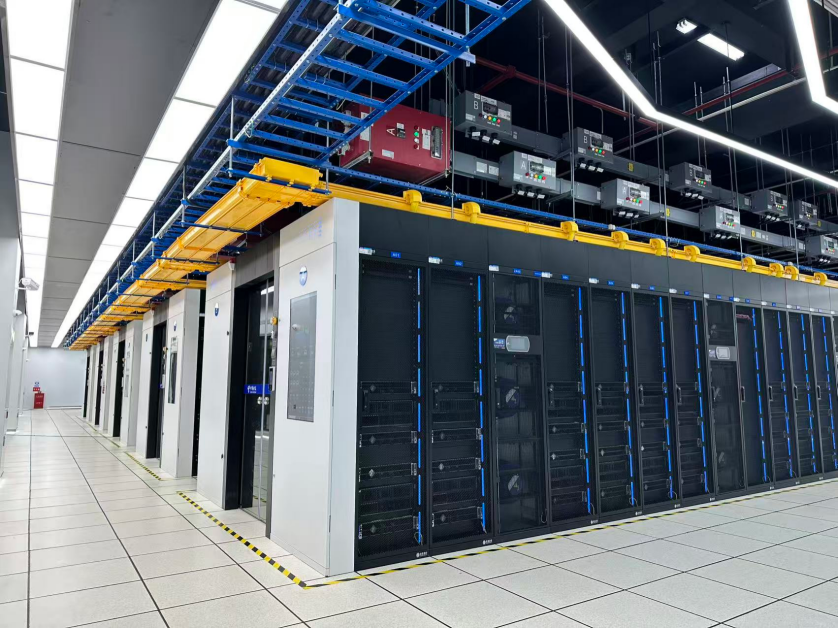
At the recently concluded 2026 World Artificial Intelligence Conference, China's artificial intelligence infrastructure sector has witnessed a landmark advancement. The Huawei Ascend 950 Super Node and Sugon's fully domestic 100,000-card AI super cluster made their public debuts. These two major achievements not only showcase China's latest breakthroughs in the deployment of ultra-large-scale intelligent computing clusters, but also mark the accelerating formation of a domestic computing power foundation, providing solid support for building a robust national digital security barrier.
As a focal point of the conference, the Huawei Ascend 950 Super Node demonstrated a leap in both single-node performance and system synergy for domestic AI chips. Built on a new-generation self-developed architecture, the super node boasts a more than threefold increase in single-node AI computing power compared to the previous generation, with memory bandwidth and interconnect throughput doubled. More importantly, from the underlying chips and high-speed interconnect buses to the upper-level management software, the Ascend 950 has achieved full-stack autonomous control. This highly integrated design effectively breaks through the "memory wall" and "communication wall" bottlenecks inherent in traditional architectures, providing tremendous computing power for the training and inference of trillion-parameter large models.
At the ultra-large-scale cluster level, Sugon's fully domestic 100,000-card AI super cluster on display was equally eye-catching. Facing the exponentially growing demand for computing power in the era of large models, this cluster not only achieves the physical aggregation of 100,000 domestic AI accelerator cards, but its ultra-large-scale cluster deployment solution also won the Technology Innovation Award at this conference. Data shows that, through a full-stack self-developed computing power scheduling system and advanced liquid cooling technology, the cluster maintains a linear speedup ratio of over 90% even at the 100,000-card scale, and reduces the data center PUE value to below 1.05. Its pioneering minute-level automatic fault recovery mechanism has completely solved the industry pain point of "a single card failure causing the entire line to shut down" in ultra-large-scale clusters, significantly improving computing power utilization.
Computing power has become the core productive force in the digital economy era. Currently, China's intelligent computing power scale is growing rapidly at an annual rate of over 50%. Against this backdrop, the implementation of the fully domestic 100,000-card AI super cluster means that China has taken a decisive step towards breaking free from external reliance on high-end computing power and achieving autonomous control over underlying technologies. This not only effectively mitigates the risk of "choke points" in the industrial chain, but also builds an impregnable digital security barrier for data security and business continuity in key sectors such as finance, government services, and energy.
From "single-point breakthroughs" to "cluster operations," domestic computing power is undergoing a profound transformation from "usable" to "highly effective." With the increasingly prosperous software and hardware collaborative ecosystem and the in-depth advancement of national computing power hub projects such as "East Data West Computing," the domestic computing power foundation will unleash greater economic multiplier effects. This will not only comprehensively empower the intelligent transformation of thousands of industries, but also inject a continuous and strong momentum into the high-quality and sustainable development of China's digital economy.