
Inclusive Institutions Nourish Silently as the "Hard-Tech Army" Grows Vigorously
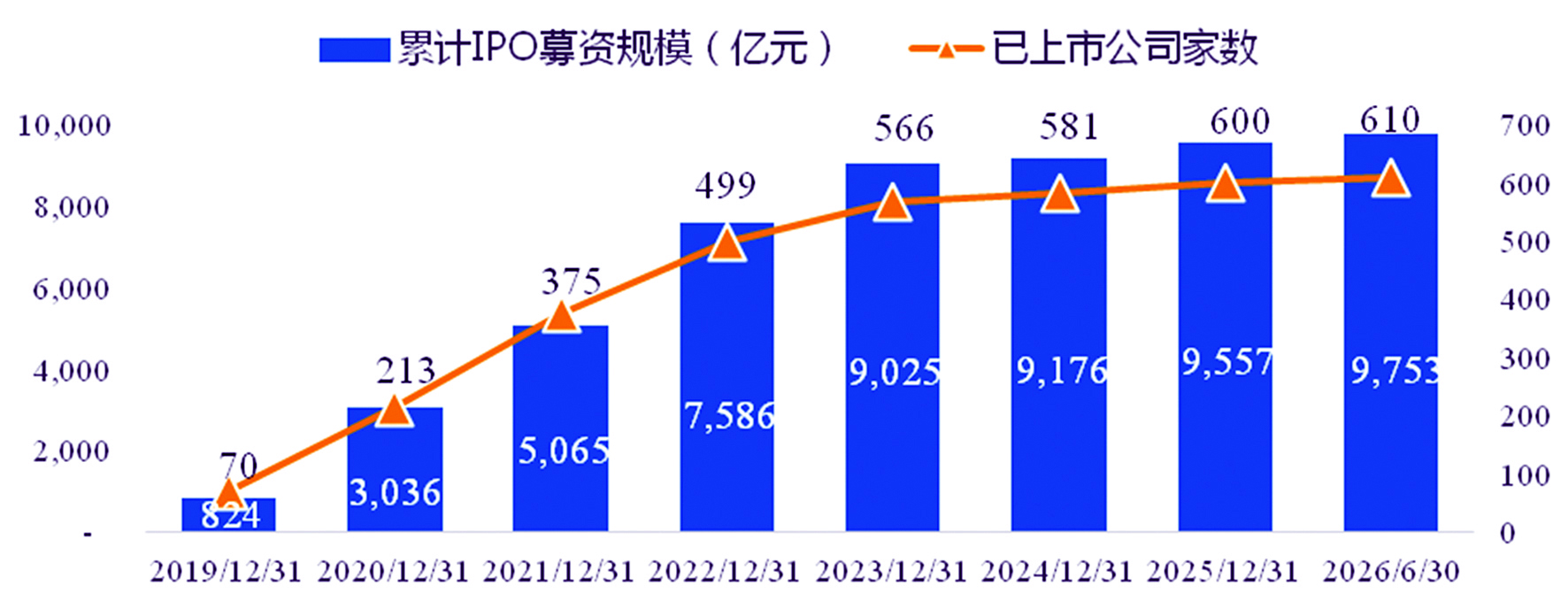
On July 22, 2026, the STAR Market celebrates its seventh anniversary since its launch. Seven years ago, the first batch of 25 companies on the STAR Market were officially listed, initiating the exploration of the capital market in serving new quality productive forces. Since then, the STAR Market has successively advanced three rounds of systematic reforms, focusing on enhancing the inclusiveness and adaptability of the capital market system. Today, the "hard-tech army" composed of 611 enterprises is thriving and taking shape. The "Chinese chips" in integrated circuits are beating faster, the "computing power network" of artificial intelligence is linking the future, and the "innovative drugs" in biomedicine are setting sail for overseas markets... These seven years have not only seen a significant increase in the "tech content" of the capital market, but also marked seven years of renewal and reshaping of China's industrial landscape.
From the "Experimental Field" to the "Demonstration Field" of Reform, the STAR Market Has Achieved a Substantial and Hardcore Report Card. On the occasion of the seventh anniversary of the STAR Market's launch,
Preferred Destination for Hard-Tech Enterprise Listings: 611 Enterprises Raised Over 1.2 Trillion Yuan
HYC Technology secured the stock code 688001, known as the "first stock of the STAR Market." Cheng Zhong, Deputy General Manager and CFO of the company, while being interviewed
Starting from the first batch of 25 enterprises seven years ago, the STAR Market has now gathered 611 hard-tech enterprises, with a total of over 1.2 trillion yuan raised through IPOs and refinancing, making it the well-deserved preferred destination for hard-tech enterprise listings.
Behind the continuous expansion of the sector lies the STAR Market's ongoing deepening of reforms, continuously polishing its distinctive positioning as "hard-tech." In response to the characteristics of scientific and technological innovation such as "long cycles, large investments, and high uncertainty," it has enhanced the inclusiveness and adaptability of its system. Over the past seven years, the STAR Market has successively advanced three rounds of systematic reforms: the "pilot registration-based IPO system," the "Eight Measures for the STAR Market," and "STAR Market 1+6," continuously leveraging institutional innovation across the entire chain and tailor-making a growth soil for hard-tech enterprises.
Among them, the pilot registration-based IPO reform built a listing system adapted to sci-tech innovation enterprises from 0 to 1. For the first time, it accepted unprofitable enterprises, red-chip enterprises, and enterprises with weighted voting rights for listing, solving the core problem of mismatch between the profit and scale thresholds under the traditional approval system and the growth characteristics of sci-tech enterprises.
In 2024, the "Eight Measures for the STAR Market" were implemented, covering a series of solid institutional innovations such as the recognition criteria for "light assets and high R&D investment" in refinancing, and installment payment of shares as consideration in M&A reorganizations.
In 2025, the "STAR Market 1+6" reform was officially launched, establishing the Sci-Tech Innovation Growth Tier, optimizing the fifth set of listing standards, and expanding and upgrading the coverage to include more frontier technology fields such as artificial intelligence, commercial aerospace, and low-altitude economy. At the same time, innovative arrangements such as the introduction of a pre-review mechanism and qualified professional institutional investors were introduced, enhancing the inclusiveness of the capital market towards high-quality unprofitable enterprises.
This year, the reform of the STAR Market has been further deepened: first, the scope of application of the fifth set of listing standards has been expanded to the field of artificial intelligence, actively supporting the listing of high-quality large AI model enterprises; second, implementing the strategic deployment of developing future industries, supporting more hard-tech enterprises in fields such as quantum technology, bio-manufacturing, and embodied intelligence to list on the STAR Market. Incremental reform measures are being implemented one after another, further consolidating the core position of the capital market in serving the main arena of new quality productive forces.
A relevant person in charge from CICC told reporters that over the seven years since its launch, the STAR Market has moved from breaking the ice on access to solve the problem of "whether there is or not," to reaching a market consensus on "how to promote," and then to tackling the era's test questions of "how to better serve" long-cycle and high-investment frontier sci-tech innovation. The continuous reform of the STAR Market has broken the single profit threshold, accepted hard-tech enterprises at different growth stages and with different development characteristics, reshaped the pricing logic, and shifted the valuation anchor under both the approval and registration systems from P/E ratio constraints to market-oriented value discovery.
Inclusive Institutions Help Enterprises Enter the Fast Track of Growth: 28 Unprofitable Enterprises Have "Dropped the U"
On July 21, TaiNuomabo, an enterprise under the fifth set of listing standards, landed on the STAR Market, becoming another unprofitable enterprise at the time of listing on the STAR Market. By adding a listing channel for unprofitable hard-tech enterprises, the STAR Market has enabled a group of hard-tech enterprises once barred from the A-share market to enter the capital market. In the "1+6" reform measures of the STAR Market, by establishing the Sci-Tech Innovation Growth Tier and restarting the fifth set of listing standards, it clearly supports the listing of high-quality unprofitable sci-tech enterprises with key core technologies, great market potential, and prominent sci-tech attributes on the STAR Market. This arrangement is not a simple expansion, but a more precise cultivation and support based on the growth laws of frontier sci-tech enterprises.
As of now, the STAR Market has supported 63 unprofitable enterprises, of which 24 are under the fifth set of listing standards. A relevant person in charge from CICC said that reform measures such as establishing the Sci-Tech Innovation Growth Tier, introducing innovative systems like pre-review, and expanding the fifth set of listing standards precisely adapt to the development requirements of new quality productive forces and better meet the financing needs of future industries and unprofitable frontier enterprises.
Heyuan Bio is one of the first newly registered companies in the Sci-Tech Innovation Growth Tier of the STAR Market. Yang Daichang, Chairman and General Manager of the company, said in an interview with reporters: "Listing is a leapfrog development for the company. Without listing in the Sci-Tech Innovation Growth Tier of the STAR Market, the company's industrialization process would not have been so fast."
Under the care of institutional inclusiveness, a group of hard-tech enterprises has been able to take off rapidly. Piotech, a leading enterprise in the field of semiconductor thin-film deposition equipment, achieved profitability in its first year of listing. Lv Guangquan, Chairman of the company, once said that listing on the STAR Market is an "accelerator" for the company's development. Before listing, the company faced challenges such as large R&D investment and tight funding needs. After listing, it broke through development bottlenecks with the help of the STAR Market platform and entered the fast track of growth.
Getting in is important, but staying firm is even more crucial. After listing, many unprofitable enterprises have shown strong performance growth. Data shows that among the 63 unprofitable enterprises, 28 have achieved profitability and "dropped the U" after listing, while the other 35 companies saw a year-on-year revenue growth of 18% in 2025 and a year-on-year net profit loss reduction of 18%.
Hardcore Innovation Forges Solid Operational Performance: R&D Investment Intensity Remains Nearly 13% for Seven Consecutive Years
Over the past seven years, the STAR Market sector has maintained an R&D investment intensity of nearly 13%, significantly leading the R&D investment intensity of the whole society, and firmly ranking first among all A-share sectors in R&D investment intensity, with its hard-tech identity becoming increasingly prominent. By the end of 2025, the cumulative R&D investment of STAR Market companies approached 900 billion yuan, and R&D investment showed a steady growth trend, with a compound growth rate of 7.5% over the past three years.
Continuous increases in R&D investment have ultimately been transformed into tangible industrial achievements. Currently, 35 STAR Market companies rank first globally in specific细分 industries or individual products, 124 companies rank first nationally, and 196 companies rank in the top five globally or nationally. 141 enterprises have been recognized as manufacturing single champion enterprises or possess single champion products, becoming benchmarks for innovative development in specific fields.
STAR Market enterprises have the courage to tackle core technologies and solve "choke point" problems in the industry. A total of 164 projects led or participated in by 96 enterprises have won major awards such as the National Science and Technology Award. In terms of innovation attributes, over 30% of STAR Market companies' products or projects under research are pioneering in the industry, filling domestic technological gaps; over 80% of companies' core products target import substitution and independent controllability.
As one of the first batch of listed enterprises on the STAR Market, HYC Technology has witnessed the full-chain upgrade of the sector's capital empowering R&D, talent, and industry. Cheng Zhong said: "In the early years, the company rented factory space. The STAR Market opened up financing channels for the company, with IPO funds raised and convertible bond financing continuously invested in capacity expansion and high-intensity R&D investment; at the same time, relying on the institutional dividends of the STAR Market, the company has launched multiple equity incentive plans to continuously attract core talents in R&D and sales."
Innovation achievements have been successively transformed into business momentum for enterprises. Based on 2019, by the end of 2025, the compound growth rates of operating revenue and net profit attributable to the parent of STAR Market companies over the past six years have reached 17% and 11% respectively.
Building a Gathering Place for Emerging and Future Industries:
The Number of Integrated Circuit and Biomedicine Enterprises Reaches 130 and 119 Respectively
Jianxin Superconductor was listed on the STAR Market just last year. Xu Jianyi, Chairman of the Company, said in an interview with reporters that in 2013, the company began R&D of liquid helium-free superconducting magnets. At that time, no company in the world had successfully developed one. "Investing over 10 million yuan every year was a significant investment for a private enterprise, and it was uncertain whether it would be successful or when it would succeed. The team tackled technical problems one by one and finally succeeded after nearly seven years of development."
"The story of the STAR Market is not about 'packaging', but about an 'evidence chain' that stands up to thorough scrutiny. The market has now validated the global trend towards helium-free technology, which is a microcosm of China's hard technology going global," said Xu Jianyi.
Such stories are frequently played out on the STAR Market. Since its opening, the STAR Market has become a gathering place for emerging and future industries such as integrated circuits, biomedicine, artificial intelligence, and high-end manufacturing, building a matrix-style industrial cluster led by industry "chain owners" with coordinated development of upstream and downstream enterprises.
Taking integrated circuits as an example, the number of listed companies in the integrated circuit sector on the STAR Market has reached 130, covering all links of the industrial chain including chip design, manufacturing, packaging and testing, equipment, materials, and software. It has gathered major industry leaders such as Hygon Information, Cambricon, SMIC, AMEC, and SJ Semiconductor.
In the field of biomedicine, the STAR Market has gathered 119 companies. A group of enterprises including BeiGene, Baili Tianheng, and Sunshine Guojian have promoted major breakthroughs in "going global" for domestically produced innovative drugs. The potential cumulative total of global patent licensing transactions for the R&D pipelines of STAR Market biomedicine companies has exceeded 45 billion US dollars.
The STAR Market is becoming the core capital market fulcrum and capital empowerment platform for China's future industrial planning and layout. More than 40 companies have taken the lead in deploying in frontier tracks such as quantum technology, 6G communication, and bio-manufacturing, accelerating the breakthrough of key core technologies and the implementation of industrialization scenarios.
At the same time, the segmented industries supported by the STAR Market continue to expand. Following the expansion of the fifth set of listing standards in 2025 to frontier fields such as artificial intelligence, commercial aerospace, and low-altitude economy, Wu Qing, Chairman of the CSRC, announced at the 2026 Lujiazui Forum in June this year that the STAR Market will expand the scope of the fifth set of listing standards to the field of artificial intelligence large models, while supporting the listing of hard technology enterprises in more fields such as quantum technology, bio-manufacturing, and embodied intelligence. With the STAR Market as a fulcrum, "Chinese technology" is reshaping the global innovation industry landscape with irresistible momentum.
Building a "Technology-Industry-Capital" Sci-Tech Innovation Ecosystem:
90% of Companies Received Venture Capital Investment Before Listing
The launch of the STAR Market has played an important role in smoothing the "technology-industry-capital" cycle. Data shows that about 90% of STAR Market companies received investment from venture capital institutions before listing, driving the formation of a trend of "investing early, investing small, and investing in hard technology."
Sun Jiatao, Executive President of Haiwang Capital of Pudong Sci-Tech Innovation Group, once frankly told reporters that without the STAR Market, many sci-tech innovation enterprises might have long been submerged in the market waves. "Before 2018, investment institutions preferred projects in the Internet and mass consumption fields. Targets like STAR Market enterprises had huge R&D investments, had not yet opened up revenue scale, and profitability was even more out of reach, so few institutions showed interest."
"When we led the Series D investment in BioSciTech in 2019, the company was not yet profitable, its self-developed pipeline was still in the early stage, and there were obvious divergences in the market regarding its commercialization prospects," said Zhang Leidie, Secretary of the Party Committee and General Manager of China Life Equity. However, the fully humanized mouse underlying technology platform it built is precisely the indispensable "infrastructure" for China's innovative drug R&D. This "industrial base" attribute is far more strategically valuable than short-term revenue figures. In December 2025, the company was listed on the STAR Market, verifying the initial judgment with actual performance.
Reform never stops, and innovation knows no bounds. The "1+6" reform of the STAR Market introduced the system of senior professional institutional investors, supporting unprofitable enterprises under review to increase capital and expand shares to existing shareholders, further smoothing the benign cycle of "technology-industry-capital."
Taking Transcenta Biopharmaceuticals, which was recently listed, as an example, Transcenta Biopharmaceuticals has identified Zhuhai Hillhouse as a senior professional institutional investor, which is also the first investment institution identified on the STAR Market. This move aims to leverage the vision of professional institutions such as top venture capital and industrial funds to inject market wisdom into the precise identification of sci-tech innovation enterprises.
Strengthening and Supplementing Industrial Chains: Over 200 M&A Deals Disclosed in the Past Two Years
Recently, the transaction in which SMIC acquired a 49% equity stake in SMIC North for 40.6 billion yuan was officially completed, becoming the largest share issuance for asset acquisition transaction since the establishment of the STAR Market.
At present, the pace of implementing M&A and restructuring projects on the STAR Market continues to accelerate. On July 16, the project in which Xindao Technology issued convertible bonds and supported cash to acquire Shunlei Technology was approved by the M&A and Restructuring Review Committee of the SSE, becoming another benchmark case of "supplementing and strengthening the chain" for STAR Market enterprises. Previously, on June 26 and July 9, the two restructurings of Primarius acquiring Ruitron and Hua Hong Macroforce acquiring Huali Microelectronics successively obtained the registration approval of the CSRC.
Since the release of the "Eight Measures for the STAR Market", STAR Market companies have disclosed a cumulative total of over 220 equity acquisition transactions, including 59 major asset restructurings (including share issuance and large cash acquisitions). In 2026, 53 new M&A transactions have been disclosed, including 7 major asset restructurings.
A batch of first-of-their-kind cases, such as acquiring unprofitable enterprises, installment payment of share consideration plus "reverse linkage" of private venture capital, and simplified review procedures, have been implemented one after another, providing support for hard technology enterprises to supplement, extend, and strengthen their chains. The institutional dividends of reform are continuously being transformed into actual results of industrial integration.
Taking AMEC's acquisition of a 64.69% equity stake in Hangzhou Zhonggui as an example, this is not only the first case on the STAR Market to apply the simplified review procedure for M&A and restructuring, but also stacks multiple innovative arrangements such as acquiring unprofitable assets, differential pricing, and market approach valuation. Although Hangzhou Zhonggui has not yet achieved profitability, its core technology has been verified by mainstream downstream customers. The transaction set revenue assessment indicators for the target company from 2026 to 2028. At the valuation level, the market approach assessment adapted to sci-tech innovation enterprises was adopted to quantify non-financial core values such as technological barriers, customer resources, and long-term market space. Differential consideration was distinguished according to the counterparty's shareholding cost, holding period, and performance commitment responsibilities, effectively balancing the demands of all parties and facilitating the completion of the transaction.
Industrial integration on the STAR Market has gone beyond simple scale superposition. It is a key move to optimize resource allocation in the field of new quality productive forces, unblock the market's "fundraising, investment, management, and withdrawal", and cultivate sci-tech "chain owner" leading enterprises.
Important Allocation Target for "Patient Capital": 33 Indices Launched, Product Scale Exceeds 310 Billion Yuan
At present, the STAR Market has formed an index system composed of broad-based, thematic, and strategy indices. The total number of indices has reached 33, the number of listed STAR Market ETFs exceeds 120, and the scale of tracking products exceeds 310 billion yuan.
The overall leap in index scale has driven STAR Market companies to gradually become one of the allocation targets for "patient capital". Among them, the domestic and overseas scale of STAR 50 products is nearly 150 billion yuan, which has become the third largest broad-based index product and the largest single-market ETF product in China.
With the continuous optimization of policies and systems and the continuous expansion of high-quality supply, institutional investors have said that in the next three to five years, the allocation ratio of institutional funds in the STAR Market still has room for improvement of 5 to 10 percentage points, and is expected to reach 20% to 25%.
"The STAR Market is still in the early to mid-stage of allocation improvement. If landmark events such as the emergence of trillion-level sci-tech leaders and inclusion in mainstream international indices occur subsequently, the allocation process may further accelerate," said the institution.
The institution also pointed out that the current investor structure still has shortcomings; the market's tendencies toward short-term trading and swing speculation make it difficult to fully reflect the intrinsic value of sci-tech innovation enterprises with long development cycles. This, to a certain extent, constrains the allocation of long-term capital. He advises institutional investors to leverage industry research and a philosophy of long-term value investing to precisely identify high-quality sci-tech innovation enterprises equipped with core technologies and sustained innovation capabilities, thereby guiding market resources toward "hard tech" entities that truly possess long-term competitiveness.
Standing at the new starting point of its seventh anniversary, the reform trajectory of the STAR Market remains clear: forging ahead toward the "new" with relentless strides. Looking ahead, the STAR Market will surely make new contributions in the grand voyage of fostering new quality productive forces, rowing with determination and forging steadily ahead toward the stars and the sea.